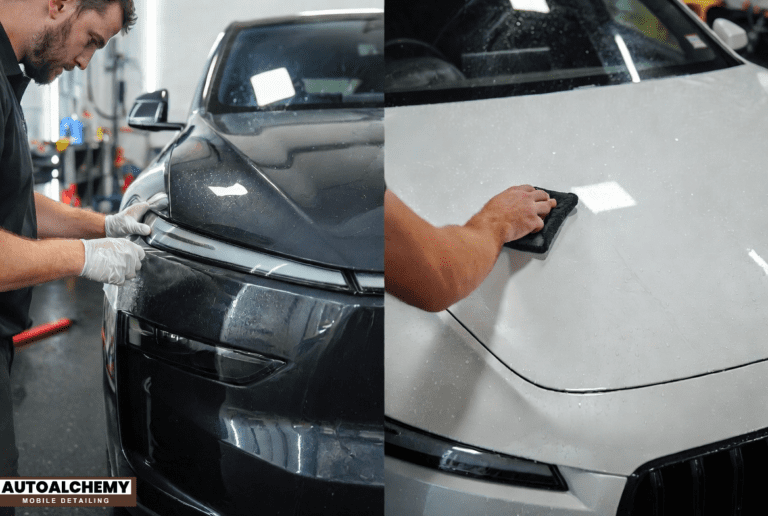
Ceramic Coating for Cars in Vancouver: Complete Protection & Maintenance Guide
Vancouver’s climate—with 1,400mm annual rainfall and frequent humidity—poses unique challenges to vehicle paint. Salt spray, UV exposure, and moisture create the perfect storm for
paint damage: oxidation, water spotting, and protective coating degradation that happens faster here than anywhere in Canada.
You’ve likely seen cars around the Lower Mainland that look showroom-fresh years after purchase, while others deteriorate rapidly despite regular washing. The difference? Professional ceramic coating.
This comprehensive guide—written by certified detailers who’ve applied ceramic coating to thousands of Metro Vancouver vehicles—reveals everything you need to know: what ceramic coating actually is, why it’s different from traditional wax, real costs in Vancouver, how long protection lasts, and exactly how to maintain your coated vehicle for maximum longevity. Whether you drive a luxury vehicle you want to protect, a daily driver experiencing paint damage, or you’re considering what protection makes sense for Vancouver’s climate, this guide cuts through marketing hype and provides facts backed by years of hands-on experience.
What is Ceramic Coating and How Does It Actually Work?
Ceramic coating isn’t magic—it’s chemistry and physics working together to create a protective layer your paint has never had.
Here’s what happens at the molecular level: A liquid ceramic (silicon dioxide-based compound, typically with 9H hardness rating) is applied to your vehicle’s paint. It chemically bonds—not just sits on top—creating a semi-permanent layer that’s exponentially harder than your factory clear coat.
Think of it this way: your car’s clear coat is like a single layer of armor plating. Ceramic coating adds a hardened shield on top—one that’s 3-5 times harder than clear coat alone, with specific properties your paint never had.
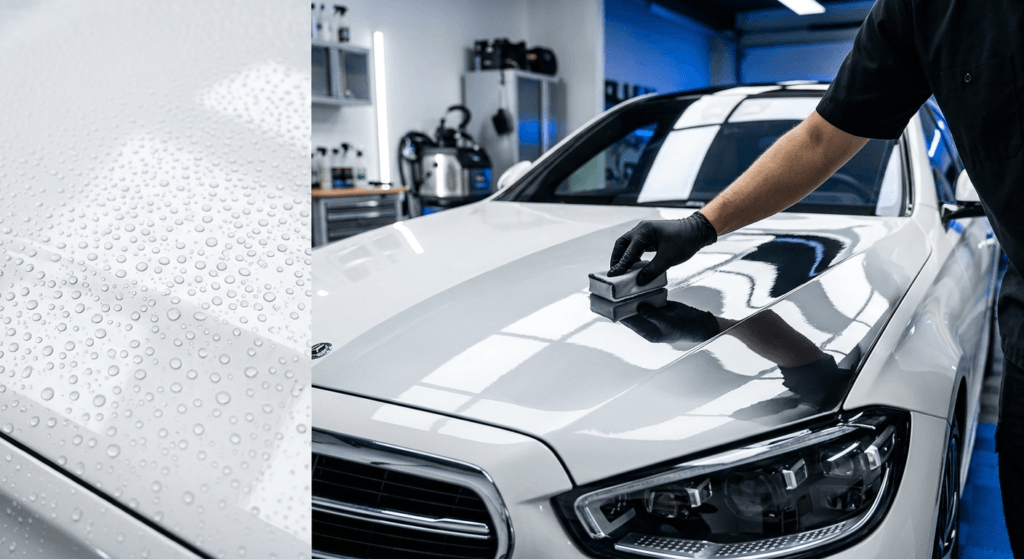
What ceramic coating actually does: The layer creates a hydrophobic surface—water literally beads up and rolls off rather than settling in droplets. This prevents water spotting, the most common paint damage in Vancouver’s rainy climate. Rain doesn’t sit on your paint; it rolls away.
The coating becomes self-cleaning. Dirt doesn’t adhere as easily. When rain hits, contamination slides off instead of bonding to the paint surface where it would cause swirling and oxidation.
UV protection is built in. The ceramic layer absorbs ultraviolet radiation that would otherwise degrade your clear coat. In Vancouver’s frequent cloud cover, you might think UV isn’t an issue—but when the sun does emerge, the damage accelerates. Ceramic coating handles this.
Chemical resistance means salt spray, bird droppings, tree sap, and road grime that would etch paint now slide off harmlessly. This is critical in Metro Vancouver where salted winter roads are common.
Is Ceramic Coating the Same as Wax?
No. Wax is temporary—lasting 2-3 months—and sits on your clear coat like a protective layer that gradually wears away. You’ll notice your car needs re-waxing when water stops beading and starts spreading.
Ceramic coating is semi-permanent—lasting 2-5 years (sometimes longer with proper maintenance)—and bonds to the clear coat chemically. It doesn’t wash away; it breaks down layer by layer extremely slowly.
Wax is like a temporary raincoat. Ceramic coating is like having treated your vehicle’s clear coat to become weather-resistant itself.
Why Vancouver's Climate Makes Ceramic Coating Essential
Why Vancouver Drivers Need Ceramic Coating (And Why You Might Be Damaging Your Paint Without It)
Not every region needs ceramic coating equally. Los Angeles drivers in dry climates? They can get away with traditional wax. Vancouver drivers? You’re fighting an environmental battle without professional protection.
The Vancouver Paint Problem: Metro Vancouver receives more annual rainfall than most Canadian cities. That 1,400mm isn’t just water—it’s acidic water containing salt particles (especially in winter), tree pollen, and minerals. Your untreated clear coat absorbs this like a sponge.
Here’s what happens without protection: Rain sits on your paint. Minerals in that water (calcium, magnesium salts from road treatment) bond to your clear coat, creating water spots that etch the paint. You can’t simply wash these away—they’ve chemically damaged the clear coat.
Repeat this cycle daily for a few months, and your paint’s finish deteriorates noticeably. Oxidation accelerates. Your car looks 5 years older than it actually is.
Tree Sap, Bird Droppings, and Road Contamination: Coastal Vancouver’s proximity to forests means constant tree sap—amber sticky substance that etches paint if not removed immediately. Imagine if your windshield had sap on it for weeks; that’s what happens to your hood without protection.
Bird droppings are acidic. They etch paint incredibly fast. Without ceramic coating, a single incident can create permanent damage in days.
Road Salt and Winter Driving: Vancouver winters mean salted roads despite milder temperatures than other Canadian cities. That salt spray bonds to untreated clear coat, initiating corrosion that spreads underneath the paint.
The Cost of Not Protecting Your Paint
Professional paint correction—removing oxidation, water spots, and etching to restore your finish—costs $800-$2,000. Prevention through ceramic coating costs $600-$1,500.
Over your vehicle’s lifetime, ceramic coating saves money, maintains resale value, and keeps your car looking pristine instead of showing its age.
How Professional Ceramic Coating Is Applied: The Complete 5-Step Process
Understanding the process explains why ceramic coating costs what it does—and why DIY attempts typically fail.
Step 1: Paint Inspection and Assessment (30 minutes)
Before any coating is applied, we thoroughly inspect your paint. A detail inspection using specialized light reveals:
- Existing damage (swirls, scratches, water spots)
- Clear coat thickness
- Paint condition
- Areas needing pre-treatment
This assessment determines whether simple coating application will work or if paint correction is needed first. A car with damaged clear coat won’t show ceramic coating benefits until that damage is addressed.
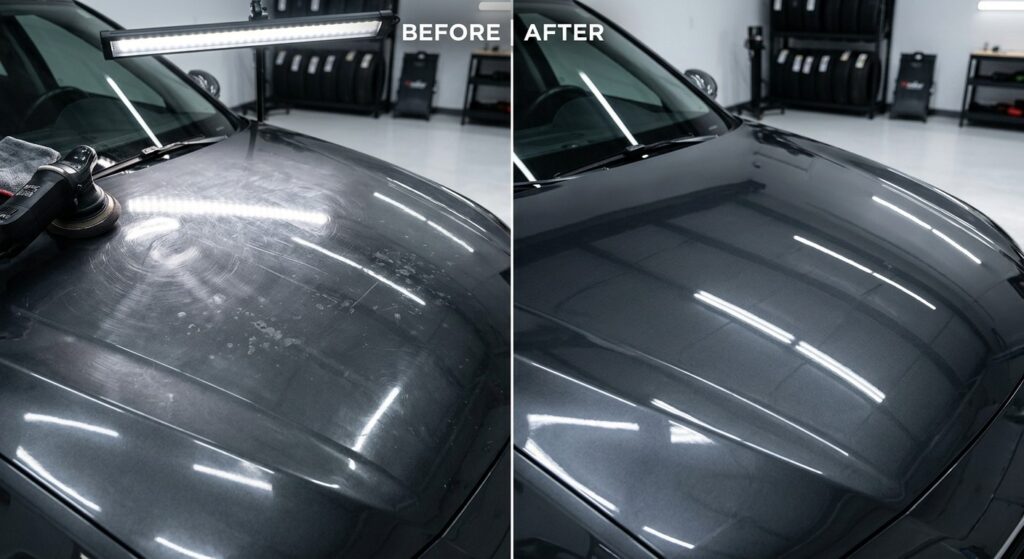
Step 2: Comprehensive Paint Correction (Varies: 2-6 hours)
If damage is present, paint correction removes swirls and scratches without sanding through clear coat. This uses:
- Dual-action polishers
- Progressive compound stages (coarse to fine)
- Specialized pads
- Precision technique to preserve maximum clear coat thickness
This step separates professional ceramic coating from amateur applications. Without correction, you’re coating damaged paint.
Step 3: Paint Decontamination (45 minutes)
After correction, we remove microscopic contamination your eye can’t see:
- Iron particles from brake dust
- Industrial fallout
- Tar and overspray residue
- Mineral deposits
Using clay bar and specialized cleaners, the paint is stripped to bare, clean clear coat. This is essential—ceramic coating won’t bond properly to contaminated surfaces.
Step 4: Ceramic Coating Application (60-90 minutes)
Using precision technique, professional-grade ceramic coating is applied panel by panel:
- Thin, even application
- Proper curing time between layers
- Controlled temperature and humidity
- Manufacturer specifications
This is where professional application differs from DIY kits. Professional products contain higher SiO2 concentration and require expertise to apply evenly.
Step 5: Curing and Final Inspection (24-48 hours)
After application, the coating cures completely—typically 24-48 hours—forming its full hardness. During this time, the vehicle shouldn’t be washed or exposed to rain.
How Much Does Ceramic Coating Cost in Vancouver? (Real Prices Explained)
Transparent pricing is rare in the detailing industry. Here’s what ceramic coating actually costs in Vancouver in 2026:
Professional ceramic coating pricing
Metro Vancouver — AutoAlchemy mobile service
What affects pricing:
Vehicle Condition: A car with oxidized paint needs more correction work before coating. A newer car with minimal damage costs less overall.
Coating Type: Standard ceramic (9H hardness) costs less than graphene or hybrid coatings that offer self-healing properties.
Paint Correction Needed: This is the variable cost. A car needing minor correction might add $400; heavy oxidation adds $1,000+.
Facility Type: Shop-based applications cost more (facility overhead) than mobile services, though mobile costs vary by travel distance in Vancouver’s sprawling geography.
Is Ceramic Coating Worth the Cost?
Compare the investment to alternatives:
- No protection: Car maintains value for 3-4 years, then depreciates rapidly. Paint deteriorates visibly.
- Traditional wax: $200-$400 per application, needed every 2-3 months = $800-$1,600 yearly.
- Ceramic coating: $800-$1,200 one-time application, maintaining paint for 2-5 years.
Over 5 years, you’re choosing between:
- No protection: Visible paint deterioration, potential resale value impact
- Annual waxing: $4,000-$8,000 in services
- Ceramic coating: $1,000-$1,500, with maintained resale value
Professional detailers in Vancouver overwhelmingly recommend ceramic coating for vehicles driven in our climate. The ROI is clear when you factor in paint preservation and resale value.
Ceramic Coating Durability: How Long Does Protection Really Last in Vancouver?
The “2-5 years” timeline you’ll see everywhere is accurate but incomplete. Here’s the real story:
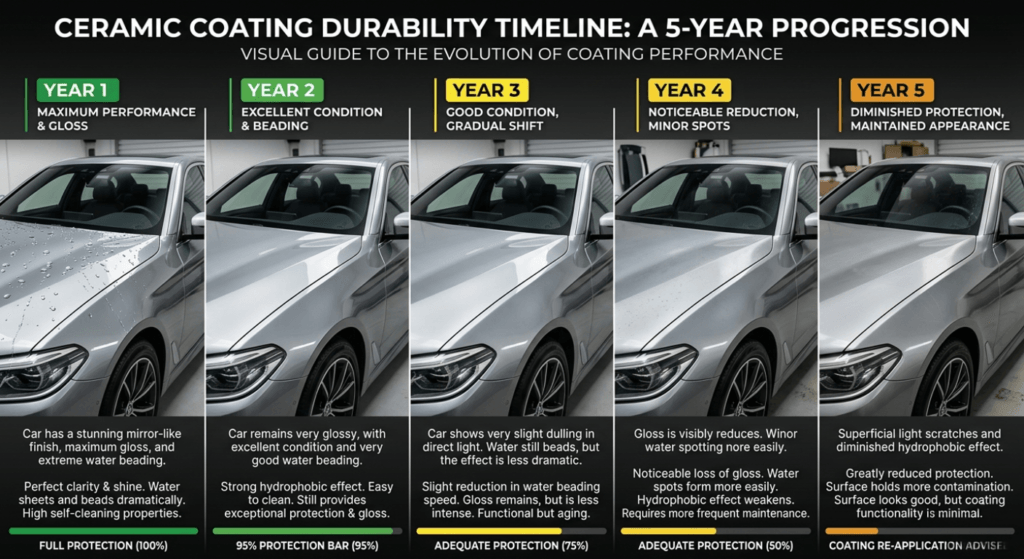
What “durability” actually means: Ceramic coating doesn’t suddenly stop working on day 1,825. Instead, it gradually breaks down from UV exposure, weathering, and oxidation. “5 years” means you’ve lost meaningful protection by year 5, not that it completely stops working.
Timeline Breakdown in Vancouver's Climate
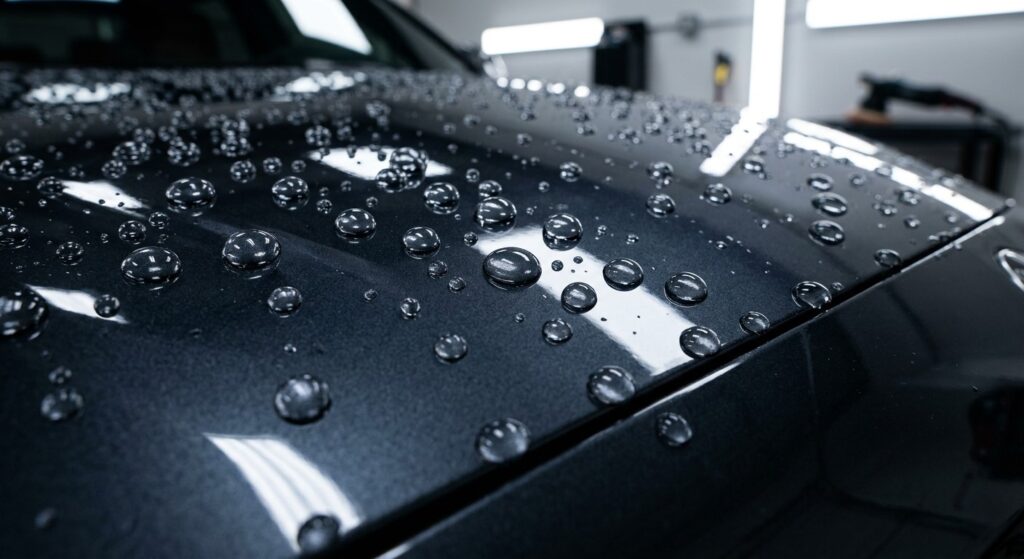
Months 1-12: Full protection. Water beads perfectly. Self-cleaning properties are obvious. This is the “wow” period where your car looks incredible.
Year 2-3: Protection remains strong. Water still beads noticeably, though not quite as dramatically. Self-cleaning is still evident. Most drivers remain satisfied.
Year 3-4: Noticeable degradation begins. Water beads less aggressively. You might notice slight water spotting returning. Paint still looks good, but you’re starting to consider re-coating.
Year 4-5: Protection is functional but diminished. Water beads irregularly. You notice water spotting after rain. Paint looks good overall but lacks the “wet” appearance of fresh ceramic.
After Year 5: You’re driving on residual protection. It’s better than having nothing, but nowhere near the benefits of fresh coating.
H3: Extending Ceramic Coating Lifespan
Proper maintenance significantly extends durability. Vehicles maintained meticulously last 4-5 years. Vehicles with neglected maintenance might need re-coating in 3 years.
Key maintenance practices:
Regular washing (2-4 weeks) with pH-neutral soap
Avoiding automatic car washes
Parking in shade when possible
Quick removal of bird droppings, tree sap, road salt
Professional maintenance wash annually
Re-coating costs: Partial re-coating (refresh) is $300-$500. Full stripping and re-coating is similar to original application ($800-$1,200).
How to Properly Maintain Ceramic Coating: Detailed Care Guide
This is where most ceramic coating projects fail. People spend $1,000 on coating, then maintain it like an untreated car.
First 7 Days After Application: Curing Phase
The coating isn’t fully hard for up to 48 hours post-application. During this period:
- ❌ Don’t wash your car
- ❌ Don’t expose to rain if possible
- ❌ Don’t drive aggressively
- ✅ Park in a garage or covered area
- ✅ Keep the vehicle dry
After 48 hours, the coating has hardened significantly but continues micro-curing for 7 days.
Regular Washing Routine
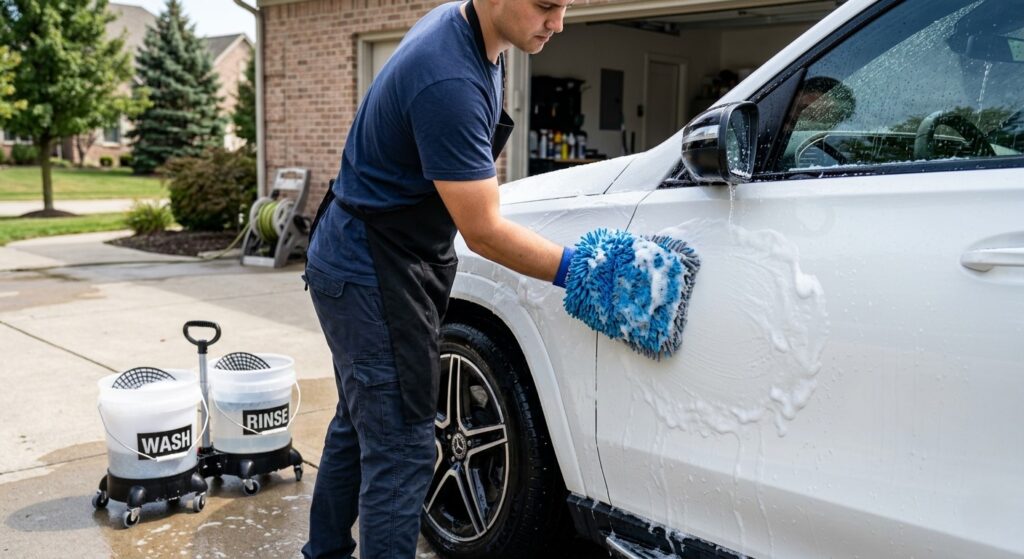
Frequency: Wash every 2-4 weeks depending on environmental conditions. Vancouver’s salt spray and rain mean more frequent washing is beneficial.
Method: Hand wash only. No automatic car washes—their harsh brushes damage the coating.
Products: Use pH-neutral car wash soap specifically formulated for ceramic-coated vehicles. Avoid harsh dish soap or alkaline products that break down the coating.
How to Wash Your Ceramic Coated Car
Proper washing preserves your ceramic coating's hydrophobic properties and extends its lifespan in Vancouver's wet climate. Follow these steps every time.
- 1 Pre-rinse first — Rinse the entire car with clean water to remove loose dirt and debris before touching the surface.
- 2 Two-bucket method — Use one bucket with pH-neutral car shampoo, one with clean rinse water. This prevents cross-contamination.
- 3 Soft microfiber mitt only — Use a high-quality microfiber wash mitt. Never use sponges or rough cloths on a coated surface.
- 4 Dry immediately — Pat dry with clean microfiber towels right after rinsing. Never air dry.
- 5 No standing water — Don't let water sit and dry on its own — especially important in Vancouver's mineral-rich water areas.
What NOT to Do with Ceramic Coating
These common mistakes destroy ceramic coatings prematurely. Avoid them to protect your investment and keep your car looking showroom-fresh year-round.
- ✕ Automatic car washes Rotating brushes create micro-scratches that compromise the coating's integrity.
- ✕ Dish soap or household cleaners Too alkaline — breaks down the ceramic bond and strips hydrophobic properties.
- ✕ Clay bar treatment Clay bars are abrasive and will physically remove the ceramic coating layer.
- ✕ Aggressive polishing or compounds Machine polishing removes the very protection you paid for. Always consult a professional.
- ✕ Ignoring water spots Hard water minerals etch through the coating if left untreated — a serious issue in Metro Vancouver.
Annual Professional Maintenance
Once yearly (ideally in spring), have a professional perform:
- Detailed wash with ceramic-safe products
- Inspection for coating degradation
- Optional ceramic coating refresh spray ($100-$200)
This maintenance significantly extends coating life and ensures you’re maximizing your investment.
What About Waxing Ceramic Coated Cars?
You don’t need to wax a ceramic-coated vehicle. The coating provides superior protection to wax. Waxing actually prevents you from assessing the coating’s condition accurately.
Frequently Asked Questions About Ceramic Coating
Q: Does ceramic coating really prevent water spots?
A: Ceramic coating doesn’t prevent water spots from forming on its surface—water spots can still appear. However, they don’t etch the ceramic layer like they etch unprotected clear coat. Water spotting is superficial on ceramic coating and washes away easily. This is fundamentally different from untreated paint where water spots etch the clear coat permanently. Think of it like water spotting on a car’s glass—annoying but not damaging. Ceramic coating makes your paint behave like glass in this regard.
Q: Can you ceramic coat a car with scratches?
A: Yes, but you’ll need paint correction first if scratches are deeper than light swirls. Light swirls and minor scratches (visible only under certain light) can be covered with ceramic coating. Deep scratches that expose primer need professional repair before coating. The ceramic coating won’t fix damage; it prevents future damage. Professional detailers will assess your specific situation during inspection.
Q: Is DIY ceramic coating as good as professional application?
A: No. DIY kits contain lower SiO2 concentrations than professional products, and application without proper equipment results in uneven coating that provides inconsistent protection. Professional application uses specialized products, proper environmental controls, and expertise that DIY doesn’t replicate. You’ll spend $200-$400 on a DIY kit for results that don’t compare to $800-$1,200 professional application.
Q: What's the best ceramic coating brand?
A: Top professional brands include Ceramic Pro, Gtechniq, Kamikaze Collection, and PPF Guard. These brands are sold only through certified detailers, not retail stores. “Professional-grade” means the product isn’t available on Amazon. If you can buy it retail, it’s typically not comparable to what professionals use. Your detailer will recommend brands they’re certified to apply.
Q: Can ceramic coating be removed?
A: Ceramic coating is semi-permanent, meaning you can’t simply wash it off. Removal requires wet sanding or polishing to physically remove the layer. This is expensive ($800-$1,500) and removes some clear coat in the process. This is why choosing a certified professional is important—removal is costly if you’re unhappy.
Q: Does ceramic coating work on matte paint?
A: Yes, and it’s highly recommended for matte finishes. Matte paint is porous and vulnerable to contamination. Ceramic coating seals the surface while maintaining the matte appearance. Matte ceramic coating products prevent the “wet” gloss appearance on matte finishes.
Q: Will ceramic coating void my car warranty?
A: Professional ceramic coating applied by certified installers doesn’t void warranties. Some manufacturers actually recommend ceramic coating. DIY applications might cause issues if they damage clear coat. Use certified professionals to ensure warranty compliance.
Ceramic Coating vs. Paint Protection Film vs. Traditional Wax: Which Is Right for Vancouver?
You have three main protection options. Here’s how they compare for Vancouver’s specific climate:
Ceramic Coating
- Durability: 2-5 years
- Protection Type: Chemical bonding, self-cleaning, hydrophobic
- Cost: $800-$1,500 (with potential correction)
- Vancouver Advantage: Excellent for water spotting prevention, salt spray protection
- Maintenance: Regular washing, professional maintenance annually
- Best For: Long-term protection, show-quality appearance, resale value
Paint Protection Film (PPF)
- Durability: 5-10 years
- Protection Type: Physical barrier, self-healing (premium grades)
- Cost: $2,000-$5,000 (full vehicle)
- Vancouver Advantage: Prevents physical damage (scratches, rock chips)
- Maintenance: Regular washing, detail inspection periodically
- Best For: High-impact areas (hood, bumper, side mirrors), stone chip prevention
Traditional Wax
- Durability: 2-3 months
- Protection Type: Temporary coating, water beading
- Cost: $200-$400 per application (2-3x yearly = $800-$1,200/year)
- Vancouver Advantage: Affordable initially, easy to apply
- Maintenance: Frequent applications required
- Best For: Budget-conscious, minimal long-term care
The Optimal Combination
For Vancouver drivers wanting maximum protection:
- Paint Protection Film on high-impact areas (hood, bumper, mirrors)
- Ceramic Coating on remaining paint
- Regular maintenance washing and annual detail
This combination costs $1,500-$2,500 initially but provides 5-10 years of comprehensive protection. Over the vehicle’s life, this is more economical than repeatedly waxing or dealing with paint damage.
Why Professional Ceramic Coating Matters: What Detailers Know That DIY Won't
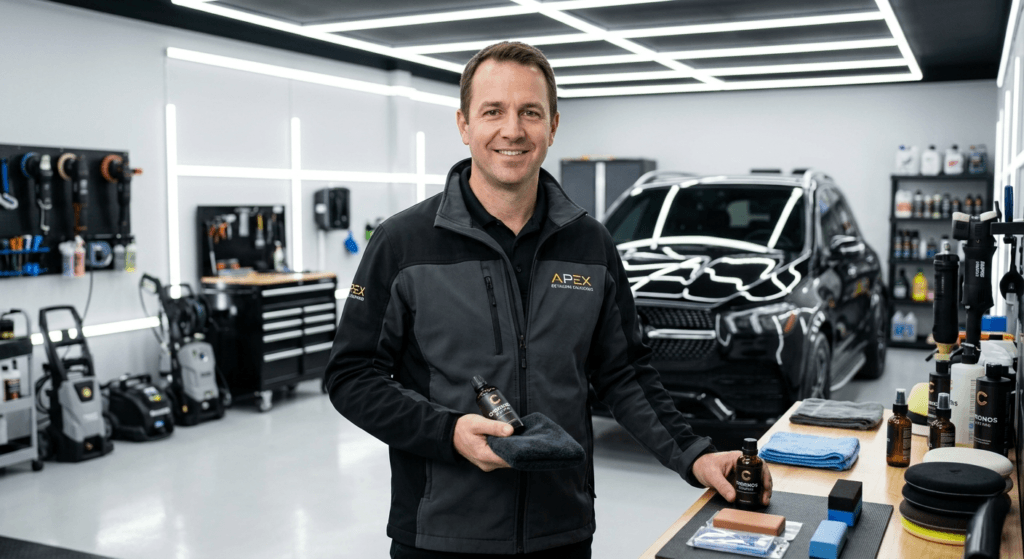
I’ve been detailing vehicles in Vancouver for 14 years. Here’s what I’ve learned about ceramic coating that marketing won’t tell you.
Paint Preparation is Everything
Most DIY ceramic coating failures happen before the coating ever goes on. People apply ceramic to dirty, contaminated, or damaged paint, then blame the product when results disappoint.
Professional installation includes:
- Clay bar decontamination removing particles you can’t see
- Paint thickness measurement ensuring clear coat is adequate
- Identification of damage requiring correction first
- Proper humidity and temperature control during application
Skip any of these steps, and ceramic coating is wasted money.
Application Technique Determines Results
A professional applies ceramic coating understanding:
- Panel-by-panel application for even coverage
- Proper curing time between layers
- Technique preventing application marks
- Environmental conditions affecting bonding
I’ve seen DIY ceramic coating where application is so uneven that water beads perfectly on one panel and sheeting runs off another. Same product, but preparation and technique created two different results.
Product Quality Matters More Than You Think
Professional-grade ceramic contains 80-90% SiO2. Consumer products contain 40-60%. That difference translates to dramatically longer durability and better protection.
It’s not marketing—it’s chemistry. Higher concentration means more durable protection, period.
Warranty and Accountability
Professional ceramic coating comes with warranties (typically 2-5 years depending on maintenance). If something goes wrong, you have recourse. DIY products? You’re on your own.
In Vancouver’s harsh climate, having professional accountability is valuable.
The Real Cost Calculation
$200 DIY kit lasting 8 months = needs replacement 6x over 4 years = $1,200 total $1,000 professional ceramic lasting 4 years = $1,000 total $1,000 professional ceramic lasting 5 years = $1,000 total
Professional application costs less when you factor in actual durability.
I recommend professional ceramic coating for anyone living in Vancouver. Not because I benefit—you’d expect that. But because 14 years of applying ceramic in this climate shows that professional installation provides protection that DIY simply doesn’t match.
Transform Your Vehicle's Protection Today
Vancouver’s wet climate demands better paint protection than what traditional waxing offers. Ceramic coating provides the durability, self-cleaning properties, and protection your vehicle needs to maintain showroom appearance for years.
The investment—$800-$1,500 for professional application—protects far more than paint. You’re preserving your vehicle’s resale value, preventing costly paint correction down the road, and enjoying the psychological benefits of a car that looks incredible no matter the weather.
Whether you drive a luxury vehicle you want to protect, a daily driver dealing with paint damage, or a new car you want to safeguard from the start, professional ceramic coating is the smart choice for Metro Vancouver drivers.
Ready to protect your vehicle's paint?
AutoAlchemy provides professional ceramic coating throughout Vancouver, Surrey, Burnaby, Langley, Richmond, and the entire Metro Vancouver area. We offer transparent pricing, certified installation, and full warranties on all ceramic coating applications.
Contact us today for a free assessment of your vehicle’s condition and personalized ceramic coating recommendation.
Schedule Your Free Ceramic Coating Consultation
Phone: +1 604-7658858
Email: info@autoalchemy.ca
Website: autoalchemy.ca